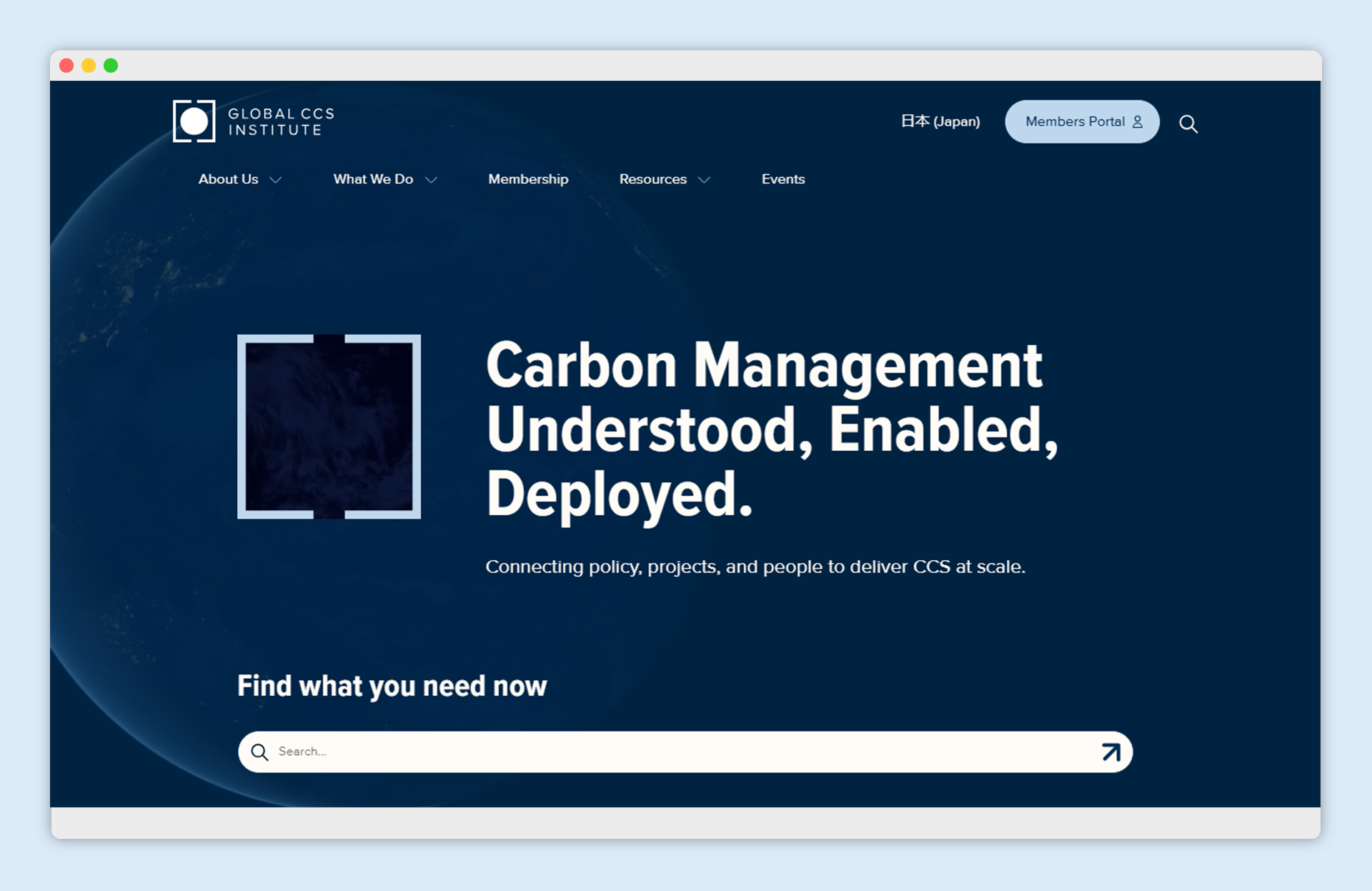
This year we were fortunate to work with the Global Carbon Capture and Storage Institute on their new website development.
It gave our team a chance to understand more about carbon capture and storage (CCS), an industry that has been through many phases on its way to validation as part of the world’s carbon reduction response.
Challenges and progress
CCS can be criticised for its high costs and economic uncertainty compared with cheaper climate solutions, and it requires significant energy required to capture and process CO₂. Other concerns are the potential for carbon leakage and the challenges with gaining enough scale to meet climate goals.
However, 2025 has seen significant progress in carbon capture and storage (CCS), despite emerging policy uncertainties in some regions.
77 commercial CCS projects are now operating with a combined capture capacity of 64 Mtpa, and a further 44 Mtpa is under construction (set to boost capacity by nearly 70%).
Many upcoming projects are first-of-a-kind at commercial scale, demonstrating CCS viability across sectors such as cement and natural gas-fired power.
CCS in Australia
Through the Carbon Capture, Use and Storage Development Fund the Australian Government has offered grants (from ~AUD 0.5 million up to AUD 25 million) to support pilot and pre-commercial CCS (and CCUS) projects.
The government also supports larger infrastructure and “hub” development via the Carbon Capture, Use and Storage Hubs and Technologies Program, which provides grants of AUD 5–50 million for activities like CO₂ transport, storage infrastructure, geological surveys and feasibility work.
Australia is home to 18 geological-storage projects with two already operational and geological capacity for long-term CO₂ sequestration. Most recently, the federal government granted “Major Project Status” to the Bonaparte Carbon Capture and Storage Project – the first offshore CCS project in Australia to receive that designation.
Technology drives diverse industry applications.
Landmark initiatives like Norway’s Longship and the UK’s East Coast Cluster are setting new standards, alongside rapid growth in CO₂ shipping solutions.
Financial-sector engagement is increasing, with non-recourse debt financing now supporting major projects. Meanwhile, industrial sectors – especially cement – and emerging technologies like DAC and BECCS are driving new demand.
However, despite progress, gigatonne-scale targets remain out of reach, underscoring the need for continued policy stability, investment, and global collaboration.
Driving change
The Global Carbon Capture and Storage Institute is an international think tank.
It accelerates the deployment of CCS by providing research, policy support, and expertise to governments, industries, and stakeholders worldwide.
Following market and like-organisation analysis, the EJ team worked through a rigorous UX, information architecture, UI design, and development process to build a site that can grow with the institute.
Primary goals were evoking the tremendous amount of activity among member organisations, the global reach of the institute, and the founding purpose of addressing climate change.
The website houses a large resource base, including many academic papers and reports that transparently define the potential of CCS technologies and support policy makers to make informed decisions.
Website development also included an events section which will enable administration of more diverse events in future: from international conferences to more intimate member exchanges.
On this project, we have learned that CCS is not the whole solution but part of the overall global emissions reduction response – particularly where carbon can be efficiently sequestered near to where it is produced. And, although projects have been slow to produce results, the tide is changing.
For motivation, look to Norway. Operating since 1996, the Sleipner CO₂ Storage Project has safely injected over 1 million tonnes of CO₂ per year into a deep saline formation in the North Sea. With nearly three decades of continuous, leak-free operation, making it the longest-running and most scientifically documented CCS project globally.
Visit the Global Carbon Capture and Storage Institute to learn about other projects.
Talk to us about UX, design and website development for sustainability initiatives and organisations.